
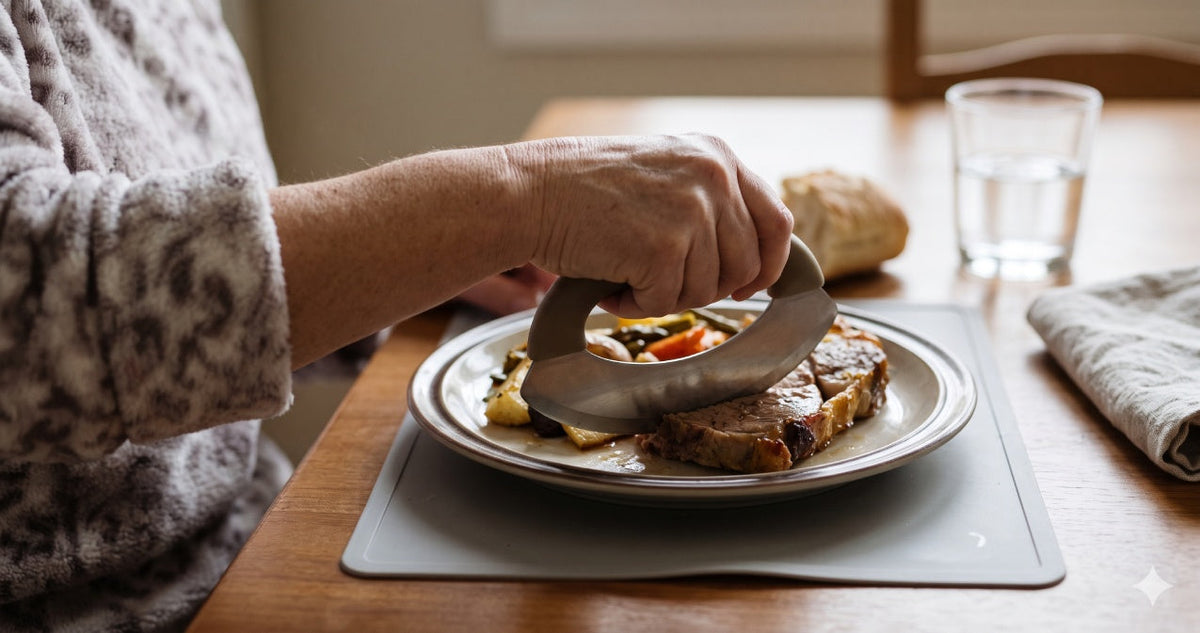
Cutting food normally takes two hands: one to steady, one to slice. When one hand is weak, painful or unavailable, that simple action can make a meal unexpectedly difficult. A rocker knife is designed to help with that cut.
How a rocker knife works
A rocker knife has a curved blade rather than a straight one. Instead of sawing back and forth, you place it on the food and rock it from side to side, letting the curve and your downward weight do the cutting.
Because the motion is a rock rather than a saw, it needs no opposing hand to hold the food steady. One hand, one movement, and the cut is made. It is one type of adaptive cutlery.
How it differs from weighted cutlery
The two are often confused because both sit in the adaptive cutlery drawer, but they solve different problems.
Weighted utensils add mass to steady a tremor. They help someone whose hands shake but who can still grip and move normally. A rocker knife addresses a different limitation: the inability to use two hands together, or to apply force through a weak wrist or grip.
Someone with Parkinson's tremor may want weighted cutlery. Someone recovering from a stroke affecting one side, or living with hemiplegia or a shoulder injury, may need to explore a rocker knife. Some people use both.
Handle and blade variations
Handles vary more than blades. A built-up foam handle widens the grip, which helps when fingers cannot close tightly. A moulded or contoured handle supports the hand in a fixed position. A vertical or pistol-grip handle lets force come from the whole arm rather than the wrist, which suits significant grip weakness.
Blades are usually stainless steel, either smooth or lightly serrated. Serrated edges handle crusty bread and tougher meat better; smooth edges are easier to clean and look less institutional on a laid table. Some rocker knives include a fork tine at the tip so the same tool cuts and then lifts the piece, which removes a utensil swap from every mouthful. The Stainless Steel Rocker Knife is one example.
What to consider before buying
Think about which hand will hold it, since some handles are shaped for left or right use. Check whether the handle diameter suits the user's grip, and whether the knife is dishwasher safe, which matters when every meal involves it.
Weight is worth a thought too: heavier knives cut more easily but tire a weak arm faster, so the best choice is not always the sturdiest one. If the knife is for someone else, their grip rather than yours is the one to match. A scoop plate can support another part of the meal.
An occupational therapist can assess which handle style suits a particular hand, and that assessment is worth having before buying several.
Medical disclaimer
This article is provided for general educational purposes only and does not constitute medical advice, diagnosis or treatment. Product information is general and may not suit every individual's circumstances. Always consult a qualified healthcare provider regarding your specific medical needs before changing any aspect of your care.
Published by the ElderShoppe Team | eldershoppe.com
Questions? Call us at the number on your site's contact page or email the address on your site's contact page.